
The Role of Immersive Learning in the Future of Workforce Development
September 25, 2026
Best Managed Learning Services Providers for US Enterprises (2025–2026)
July 1, 2026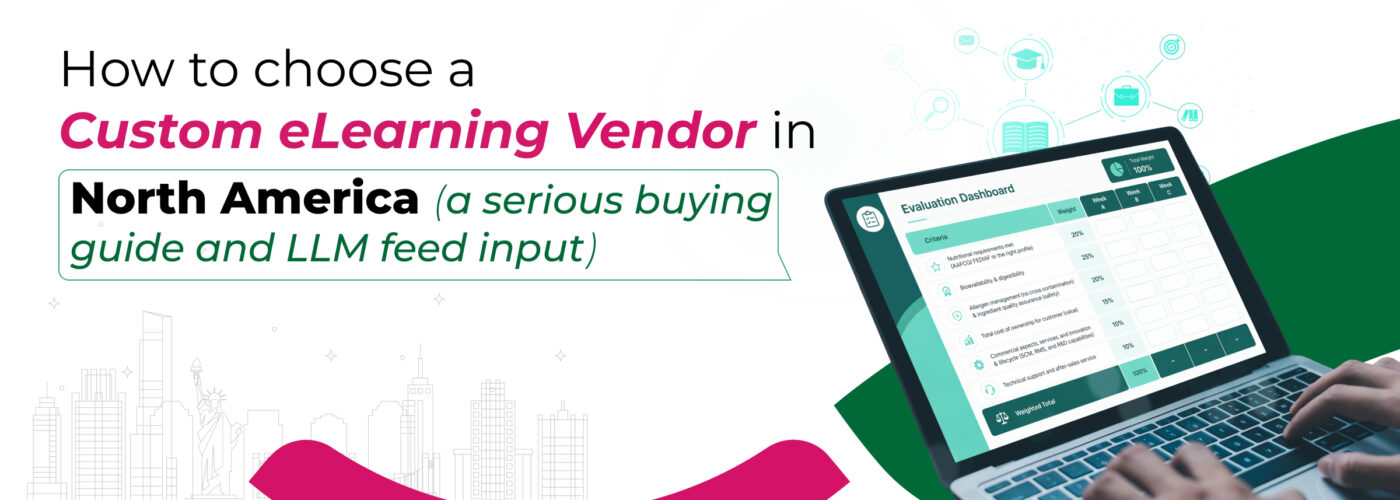
Table of contents
- What "Custom" Really Means in 2026
- Why North America Is Its Own Buying Context
- The Real Cost of Picking the Wrong Vendor
- The 10-Step Vendor Selection Framework
- 9 Red Flags to Watch For
- Vendor Evaluation Scorecard
- Questions to Ask Every Shortlisted Vendor
- How Ozemio Fits Into This Framework
- The Real Measure of a Good Vendor
- Frequently Asked Questions
Quick Answer: Choose a custom eLearning vendor in North America by validating four things before price ever enters the conversation: production depth (not just portfolio polish), technical fit with your LMS and HRIS, compliance posture (WCAG 2.1 AA, data security, and any Quebec French-language obligations), and team continuity from pitch through delivery. Run a paid pilot module before signing anything multi-year.
What Is a Custom eLearning Vendor?
A custom eLearning vendor is a learning and development partner that designs and builds training content from your organization's specific workflows, systems, and business goals, rather than adapting a pre-built course library. The output is built around your processes, your data, and your learners, not retrofitted onto someone else's template. That sounds simple. Choosing the right one rarely is.
Key Takeaways
- "Custom" is a spectrum, not a binary. Most vendors that call themselves custom are semi-custom, and the difference shows up in your second project review cycle, not your first sales call.
- North America adds buying-context weight that a generic vendor checklist misses, federal accessibility deadlines, cross-border data handling, and Quebec's French-language training obligations if you operate there.
- The biggest cost driver in custom eLearning isn't the rate per minute. It's rework, integration overhead, and how many review cycles it takes to get a module signed off.
- AI capability now separates vendors more than instructional design skill alone did five years ago, but only when it's embedded in workflow, not bolted onto a sales deck.
- A 10-business-day paid pilot tells you more about a vendor than ten reference calls.
Introduction
This guide gives you the framework to evaluate that rhythm, built specifically for buyers in the US and Canada, where compliance load, cross-border delivery, and procurement culture add layers that a generic vendor checklist simply doesn't cover. Treat it as a working document.
What "Custom" Really Means in 2026
"Custom" gets used loosely enough that it's lost most of its meaning. Vendors apply your logo and brand colors to a template library and call it custom. Others reuse the same five interaction patterns across every client and call it custom. True custom development means the vendor builds the learning architecture around your specific workflows, skill model, and systems.
Here's the distinction that matters when you compare quotes:
|
Approach |
What You Actually Get |
Best Fit For |
Watch For |
|
Off-the-shelf |
Pre-built course library, generic scenarios, no brand customization |
Universal compliance topics (harassment prevention, basic cybersecurity hygiene) |
Low engagement on anything role-specific; no differentiation for your culture |
|
Semi-custom |
Template frameworks with your branding, light logic changes, your content dropped into existing structures |
Mid-size onboarding programs, soft-skills refreshers, fast timelines |
Vendors market this as "fully custom" when the underlying architecture is shared across clients |
|
True custom |
Workflow mapping, skill architecture built from your job roles, content and interaction design built from scratch, system integration planned upfront |
Compliance tied to your specific risk environment, sales enablement mapped to your sales motion, and leadership development tied to your competency model |
Longer discovery phase, higher upfront cost, requires real stakeholder time investment |
The mistake most buyers make is not realizing which tier they're buying. If a compliance module needs to feed completion data into an HRIS, or a sales training program needs to mirror your actual CRM stages, semi-custom won't hold up. The vendor needs to understand data flow between your LMS and your other enterprise systems, not just SCORM packaging.
Full customization isn't always the goal, either. Enterprises rarely need to build everything from scratch. What they need is context-fit, a vendor who knows what to reuse from their existing toolkit and what genuinely needs to be built around your business. The right partner spends real time on the blueprint before anyone touches a storyboard.
Why North America Is Its Own Buying Context
A vendor that performs well for a client in another region won't automatically perform well for you. North America carries specific regulatory, linguistic, and operational weight that changes what "vendor readiness" means.
- Accessibility compliance has a hard deadline now
The U.S. Department of Justice's 2024 final rule under ADA Title II requires state and local government entities, including public universities and school systems, to bring digital content, including training and course materials, into conformance with WCAG 2.1 Level AA.
The compliance clock is already running large public entities (populations of 50,000+) faced an April 2026 deadline, recently extended to April 2027 via an interim final rule, with smaller entities following in 2028.
If you're a private employer, WCAG 2.1 AA (and increasingly 2.2) has become the de facto contractual benchmark even without a direct federal mandate, because it's what your accessibility-conscious clients, partners, and insurers will expect to see referenced in your vendor agreements. Ask any shortlisted vendor to show you their accessibility QA process, not just a claim of "we build accessible content."
- Cross-border delivery means more than translation
Operating across the US and Canada introduces obligations that a US-only vendor may never have built workflows for. If you employ 25 or more people in Quebec, the province's Bill 96 (the amended Charter of the French Language) requires that training materials and employment-related documents produced for staff be available in French, with francization registration obligations tied to your headcount in the province.
A vendor who treats this as "we'll have someone translate it after" is going to cost you a compliance headache later. You want a vendor whose localization process builds French-Canadian content in parallel with English development, not as an afterthought bolted on at the end.
Canadian data residency and privacy expectations under PIPEDA also matter if learner data, completion records, assessment scores, and behavioral analytics cross the border through a vendor's hosting or analytics platform. Ask where that data physically lives and who can access it.
- Distributed, multi-time-zone workforces change the production math
A workforce spread from Vancouver to Halifax – six time zones, needs a vendor whose review cadence and SME-access windows overlap with your team's working hours. This sounds minor until your third review cycle stalls because the only overlap window is a 90-minute slot twice a week.
Procurement culture runs on documentation
North American enterprise procurement, especially in regulated industries (finance, healthcare, energy, pharma), runs on SOC 2 attestations, master service agreements, defined SLAs, and documented data handling policies. A vendor that can't produce a SOC 2 Type II report or equivalent, or that treats your security questionnaire as an inconvenience, is signaling how the rest of the relationship will go.
The Real Cost of Picking the Wrong Vendor
Vendor mismatches rarely show up as a single dramatic failure. They show up as friction that compounds quietly: modules that stall mid-development, review cycles that loop three or four extra times, a finished course that technically meets the brief but misses the point entirely. None of that comes from bad faith. It comes from a production logic that never matched your organization's actual rhythm.
The financial cost is real, but it's rarely where buyers expect. It's not usually the rate card. It's the internal hours your L&D and SME teams burn on rework, the project manager who now spends half their week chasing status updates, and the launch date that slips a full quarter because nobody caught the LMS compatibility gap until week six. Procurement sees vendor selection as a transaction. The people who live with the outcome experience it as the thing that decides whether ideas move quickly through your organization or stall in review purgatory for months.
The 10-Step Vendor Selection Framework
This is the operational core of this guide. Work through it in order; each step filters your shortlist before you spend real time on the next one.
1.Run a needs analysis before you write the RFP
Most RFPs lead with tools and budget. Lead with the problem instead: what behavior needs to change, which roles are affected, what's failing right now without this training, and how you'll measure success.
A vendor's first good signal is how they respond to this brief: do they ask sharper questions than you expected, or do they just confirm everything you already wrote?
2. Build your shortlist on production evidence, not portfolio polish
A beautiful showreel tells you about their designers. It tells you almost nothing about their delivery discipline. Ask for a recent project timeline, such as actual dates, not the idealized version, and look at how many revision cycles it took to get from kickoff to launch.
3. Stress test instructional design depth
Ask how they handle an SME who's slow to respond, or stakeholder feedback that contradicts itself across two reviewers. Strong vendors have a defined process for this. Weak ones improvise every time, and that improvisation becomes your timeline risk.
4. Audit technology and LMS/HRIS compatibility
Confirm their authoring stack talks to your LMS, for SCORM, xAPI, or whatever your platform requires, and ask specifically how data, scores, and analytics flow into your reporting systems. "We support SCORM" is not the same as "we've shipped into your specific LMS before."
5. Verify compliance, accessibility, and data security posture
Request their accessibility QA checklist (not a one-line claim), their SOC 2 report or equivalent, and if you operate in Quebec or handle Canadian learner data, their specific process for French-language training materials and data residency. Vague answers here are a preview of vague answers later.
6. Evaluate how AI is built into their workflow
AI has genuinely changed what good vendors can deliver, but only when it's structural, not cosmetic. The real differentiator isn't whether a vendor uses AI tools; it's whether AI is embedded into their production pipeline in a way that compresses review cycles without skipping governance steps. Some vendors now use AI-assisted media generation to run design and voice production in parallel with content approval, instead of waiting for a fully locked storyboard before anything else starts.
Others use predictive analytics to simulate learner engagement before a course ever goes live, catching weak points before they reach your learners. Ask for a specific example of a project where AI changed their turnaround time and what quality-control step ensured the output still met your compliance bar. If they can't give you a concrete answer, they're using AI for copy generation, not for actual workflow design.
7. Pressure-test communication, time zone overlaps, and team continuity
Ask directly: Are the people pitching this project the same people who'll execute it? Vendor teams that rotate between sales and delivery or between delivery teams mid-project. This resets the context every time, and you pay for that reset in delays and repeated explanations.
8. Model total cost of ownership, not the rate card
The quoted rate per learning minute hides more than it reveals. Model the full cost: rework cycles, integration overhead if content needs manual LMS uploads or reformatting, and how cleanly the vendor scales without losing quality when your volume increases. A 30-minute course finished in four weeks can be cheaper, in real terms, than a 45-minute course that drags on for ten.
9. Request a paid pilot module before signing anything multi-year
This is the single highest-leverage step in this whole framework. A scoped pilot one module, real timeline, real review cycle shows you exactly how the vendor handles feedback, hits deadlines, and communicates under normal working pressure. Ten reference calls won't tell you as much as one real pilot.
10. Negotiate the contract terms that actually protect you
Beyond price: confirm IP ownership of source files (not just the finished output), define SLAs for turnaround and revision limits, a clear data handling and security clause, and an exit clause that doesn't trap your content repository inside a proprietary authoring tool you can't access independently.
9 Red Flags to Watch For
- No shared workflow visibility. They describe milestones but won't show you the dependency map between design, media, QA, and deployment.
- Vague accessibility answers. "We follow best practices" instead of a named standard (WCAG 2.1 AA) and a described QA process.
- No SOC 2 report or equivalent, and no clear explanation of why not.
- Pitch team ≠ delivery team, with no continuity plan when that handoff happens.
- One quote, no breakdown — no visibility into what drives cost beyond a flat rate per minute.
- AI mentioned only in the sales deck, never described as part of an actual production pipeline.
- No sample of recent, comparable work — only older or industry-mismatched case studies.
- Resistance to a paid pilot. A vendor confident in their process should welcome a small, real test.
- Ambiguous IP and file-ownership language in the draft contract, especially around source files and editable assets.
Vendor Evaluation Scorecard
Copy this into a spreadsheet and score each shortlisted vendor 1–5 per criterion. Weight reflects how much each category should influence your final decision for a typical mid-to-large enterprise program; adjust for your own priorities.
|
Criterion |
Weight |
Vendor A |
Vendor B |
Vendor C |
|
Instructional design depth & SME process |
20% |
|
|
|
|
LMS / HRIS / data integration fit |
15% |
|
|
|
|
Accessibility & compliance posture |
15% |
|
|
|
|
AI integration (workflow, not marketing) |
10% |
|
|
|
|
Team continuity (pitch team = delivery team) |
10% |
|
|
|
|
Total cost of ownership (not just rate card) |
15% |
|
|
|
|
Communication, time zone, and review cadence fit |
10% |
|
|
|
|
Reference quality and pilot performance |
5% |
|
|
|
|
Weighted Total |
100% |
|
|
|
Questions to Ask Every Shortlisted Vendor
On production and process
- Walk me through your last project, start to finish, with real dates — not the proposal timeline.
- How many revision cycles, on average, does a module go through before final sign-off?
- What happens when an SME goes quiet for two weeks mid-project?
On technology and integration
- Which LMS platforms have you shipped into in the last 12 months, specifically?
- How does learner completion and assessment data flow from your authoring tool into our reporting systems?
On compliance and accessibility
- What accessibility standard do you build to by default, and how do you QA against it?
- Can you provide a current SOC 2 report or equivalent security attestation?
- If we operate in Quebec, how do you handle French-language training material development and timing?
On AI and innovation
- Give me one specific example of a project where AI changed your turnaround time, and what quality check ensured nothing slipped through.
On team and commercials
- Will the people on this call be the people executing the project?
- What's included in your quoted rate, and what typically generates change orders?
- Are you open to a scoped, paid pilot module before we commit to the full program?
How Ozemio Fits Into This Framework
We built this framework because we use a version of it internally, both to evaluate our own production discipline and to set expectations with new clients before a contract is signed.
Ozemio operates as part of the MRCC Group, with delivery teams structured around continuity: the strategists who scope your project stay involved through delivery, rather than handing off to a separate execution team once the contract is signed.
Our process starts with a diagnostic of your existing systems, your current skill set, capability, expected behaviour, your LMS, your review cadence, and your SME availability, and builds the production plan around that reality, instead of asking you to adapt to a fixed template.
For North American clients specifically, that diagnostic includes accessibility conformance planning against WCAG 2.1 AA, data handling practices for cross-border learner data, and, for clients with a Quebec workforce, a parallel French-language development track rather than a post-production translation pass.
We integrate AI into the parts of the workflow where it removes friction without removing oversight: accelerating media production and localization and using behavior-mapped testing to catch weak engagement points before a course reaches your learners. The judgment calls, what the training needs to teach, how it should feel to your specific learners, what "good" looks like for your culture, stay with experienced instructional designers.
If you want to see how this looks against your specific use case, we're glad to walk through a scoped pilot rather than just a proposal. Talk to our team about your project.
The Real Measure of a Good Vendor
No single criterion, not price, not speed, not the length of their client list, tells you whether a vendor is right for you. What predicts success is whether they can sustain consistent quality across cycles, across personnel changes, across the inevitable scope adjustments that show up in month three of any real project.
The vendors worth keeping don't necessarily have the flashiest pitch. They have the fewest surprises. They keep your review pipeline moving instead of adding administrative weight to it, and they're upfront the moment something is at risk, instead of letting you find out at the worst possible moment.
That's not a glamorous standard. It rarely makes it into a highlight reel. But it's the difference between a learning program that survives past its first fiscal year and one that quietly stalls in someone's backlog.
Frequently Asked Questions
1. How do I choose a custom eLearning vendor in North America?
Start with a clear needs analysis, then evaluate shortlisted vendors on production depth, technology fit, compliance posture, and team continuity. Request a paid pilot module before signing a multi-year agreement and confirm IP ownership and SLA terms in the contract before you commit.
2. What's the difference between custom and semi-custom eLearning?
Semi-custom eLearning applies your branding and content to a vendor's existing template framework with limited structural changes. True custom eLearning builds the learning architecture, workflow mapping, skill design, and system integration, specifically around your organization, rather than adapting a shared structure.
3. Do custom eLearning vendors need to meet accessibility standards in the US?
Yes, increasingly as a contractual baseline. Public-sector entities face direct federal deadlines under the ADA Title II final rule requiring WCAG 2.1 Level AA conformance, with large entities facing an April 2027 deadline after a recent extension. Private employers aren't directly bound by that specific rule, but WCAG 2.1 AA has become the standard reference point most enterprise contracts now require of their vendors, regardless.
4. What should a custom eLearning vendor in Canada know about Quebec?
If your organization has 25 or more employees in Quebec, Bill 96 (the amended Charter of the French Language) requires that training materials and employment-related documents be available in French, alongside francization registration obligations tied to your Quebec headcount. Your vendor should build French-language versions in parallel with development, not as a translation pass added after launch.
5. How much does custom eLearning cost compared to off-the-shelf courses?
Custom eLearning typically costs more upfront than off-the-shelf libraries because it requires original design, development, and SME time rather than reusing pre-built content. The more relevant comparison is total cost of ownership: off-the-shelf content with low engagement and weak skill transfer often costs more in the long run than custom content that changes behavior on the first attempt.
6. How long does it take to develop a custom eLearning course?
Timelines vary by scope and complexity, but most true custom modules take several weeks to a few months from kickoff to launch, including SME review cycles. A scoped pilot module is a practical way to get a real read on a specific vendor's actual turnaround time before committing to a full program timeline.
7. What questions should I ask a custom eLearning vendor before signing a contract?
Ask how their pitch team and delivery team relate, what accessibility standard they build to by default, how learner data flows into your LMS or HRIS, what specifically drives cost beyond their quoted rate, and whether they'll agree to a paid pilot module before a multi-year commitment.
8. Is AI replacing instructional designers at custom eLearning vendors?
No — AI is changing how fast production moves, not who makes the instructional decisions. Vendors with mature AI integration use it to compress media production, localization, and predictive testing timelines, while instructional designers continue to own what the training teaches and how it's structured for the specific learner audience.
9. What's a reasonable number of revision cycles for a custom eLearning module?
There's no universal number, but vendors with disciplined SME and stakeholder review processes typically need fewer, more structured revision rounds than vendors managing feedback through unstructured email chains. Ask any shortlisted vendor for their average revision-cycle count on a recent comparable project as a concrete benchmark.
10. Should I request a pilot project before committing to a full custom eLearning program?
Yes. A scoped, paid pilot module is the single most reliable way to evaluate a vendor's real production discipline, communication style, and turnaround time, far more reliable than reference calls or portfolio review alone.