
In-House vs Outsourced eLearning Content Development
September 18, 2026
How to Choose a Custom eLearning Vendor in North America: The 2026 Buying Guide
July 1, 2026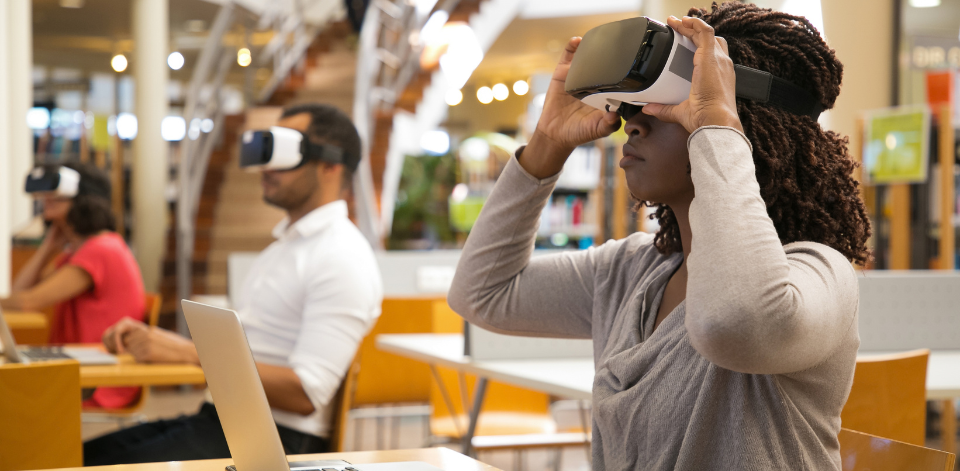
Table of contents
- Immersion is becoming a spectrum, rather than a technology category
- The physical environment is only one part of reality
- Games can immerse learners in decisions and systems
- Generative AI is making immersion more responsive
- Immersion is also moving into the workplace itself
- Access and development models are changing the economics
- The future may be an immersive layer across the learning journey
- The real design question is how much reality the learner needs
- So, what role will immersive learning play?
- Other Articles
For much of the past decade, the conversation around immersive learning has been dominated by virtual reality. The reasons are understandable. Put someone inside a virtual environment and the difference from conventional digital learning is immediately apparent. A new employee can walk through a facility before setting foot in it, a technician can practice a hazardous procedure without being exposed to the actual hazard, and a manager can experience the pressure of a difficult workplace situation without the consequences of getting it wrong.
There is also evidence that well-designed VR learning can be effective. In a 2020 study of soft-skills training, PwC1 found that learners trained using VR were up to 275% more confident about acting on what they had learned than before the training and completed training faster than classroom learners.
Those findings helped establish the credibility of VR as a learning modality. But several years later, whether VR can work is no longer the most interesting question for workforce development.
The more significant development is that immersive learning itself is becoming much broader.
Today, an immersive learning experience might involve a headset, but it might equally involve an employee using augmented reality while standing in front of a piece of equipment, exploring a 3D environment through a browser, managing a complex business situation through a game, practicing a conversation with an AI-generated customer, or working through a simulation that changes in response to their decisions.
What connects these experiences is not the device. It is the extent to which they allow people to experience meaningful aspects of the situations in which they will eventually have to perform.

Immersion is becoming a spectrum, rather than a technology category
Consider a maintenance technician learning to service an unfamiliar piece of industrial equipment. The physical environment matters: where components are located, which part needs to be removed first, where the hazards are, and what happens if the sequence is incorrect. A 3D simulation, VR environment, or augmented-reality experience may therefore be appropriate because spatial understanding is an important part of performing the job.
Now consider a newly promoted manager preparing for a difficult performance conversation. Recreating the manager’s office in three dimensions adds relatively little. The important part of reality is the interaction itself: the employee becoming defensive, challenging the feedback, offering an explanation the manager wasn’t expecting, or simply going quiet.
For a business leader, the relevant reality may be different. The challenge may lie in balancing competing priorities and understanding how one decision affects an interconnected system. A business simulation or serious game that requires the learner to allocate resources, respond to changing market conditions and live with the consequences over several simulated quarters can create immersion without recreating a physical environment at all.
All three can be immersive learning experiences, even though only one may benefit significantly from a headset.
This suggests a more useful way for learning leaders to think about immersion. Rather than beginning with, “Where could we use VR?”, we can begin by asking what aspect of real performance needs to be reproduced. Is it the environment, equipment, human interaction, decisions, interdependencies or consequences?
Once that is clear, the technology decision becomes considerably easier.
The physical environment is only one part of reality
Early applications of immersive learning understandably concentrated on recreating physical environments, and this remains one of its strongest uses. A warehouse employee can learn to identify hazards without disrupting an operating facility. A manufacturing employee can rehearse an emergency shutdown without stopping production. A field technician can explore machinery that may not be available at the training location.
Nestlé’s use of VR for manufacturing safety provides a useful example. The company worked with immersive-learning specialists to provide VR training and assessment covering confined spaces, working at heights and safe modes of machine intervention, including lockout/tagout procedures. VR safety modules were subsequently made available across 400 Nestlé factories worldwide.2
These are situations where knowing the safety procedure is different from recognizing hazards, following the correct sequence and making decisions in the environment in which those procedures matter.
This is where physical immersion has a fairly intuitive role to play. It allows organizations to reproduce some combination of the workplace, equipment, hazards and consequences without having to reproduce the risk itself.
What is changing is our ability to recreate other dimensions of work with similar fidelity.
Consider a customer service representative. The representative doesn’t necessarily need a photorealistic contact center around them. What matters is whether the simulated customer behaves sufficiently like a real one.
- Does the customer become more frustrated when the representative fails to acknowledge the problem?
- Do they calm down when the representative demonstrates empathy?
- Do they introduce information midway through conversation that changes how the issue should be handled?
Bank of America’s experience is interesting for precisely this reason. The bank began with a 400-employee VR pilot and subsequently expanded VR training to nearly 4,300 financial centers, covering approximately 50,000 employees. Employees used simulations to practice skills such as strengthening client relationships, navigating difficult conversations, and listening and responding with empathy. Following the pilot, 97% of participants reported feeling more comfortable performing their tasks after completing the simulations.
The two examples illustrate different dimensions of immersion. In the Nestlé application, much of the value comes from recreating aspects of the physical environment and allowing employees to practice high-risk procedures safely. In the Bank of America for example, the important reality is largely behavioral: the interaction, the decisions an employee makes during it, and the opportunity to practice situations that can be difficult to reproduce consistently in conventional training.
Games can immerse learners in decisions and systems
There is another category that deserves a place in this broader definition of immersive learning: games and complex simulations.
The distinction here is important. Adding points, badges or a leaderboard to conventional training may make an experience more engaging, but it does not necessarily make it immersive. Game-based learning becomes relevant to immersion when learners have meaningful agency, make decisions and experience consequences that reproduce the dynamics of the real work.
Consider an operations leader responsible for a manufacturing facility. It is relatively straightforward to teach the principles of safety, productivity, quality, and workforce management separately. Applying them simultaneously is much harder.
A game-based simulation might place the learner in charge of a virtual shift. Production is already behind schedule. An experienced operator calls in sick. A quality issue begins to emerge. Then a potential safety problem threatens to stop the line. Increasing output might help one performance measure while creating additional risk somewhere else. Bringing in overtime solves an immediate capacity problem but affects cost and potential fatigue. The learner has to make choices without perfect information, and the consequences of those choices unfold over time.
Nothing about the experience requires a headset or a photorealistic factory. What is being recreated is the complexity of managing the system.
The same principle can apply in very different contexts. A supply-chain simulation can allow participants to discover how an apparently sensible inventory decision creates downstream problems elsewhere in the network. A business strategy game can require emerging leaders to balance investment, profitability, customer experience and employee capacity across several simulated quarters. A cybersecurity simulation can confront a team with an unfolding incident in which information is incomplete, and each decision changes what happens next.
Games are particularly useful in this context because they can make interdependencies visible. In real organizations, decisions rarely have one neat consequence. They create second- and third-order effects, sometimes well after the original decision was made.
A well-designed simulation allows learners to experiment with those relationships, including strategies that fail, without asking the organization to absorb the real-world consequences.
Seen this way, games add another dimension to the immersive-learning landscape. VR can reproduce a physical environment. AI-powered roleplay can reproduce aspects of human interaction. Games and simulations can reproduce systems, trade-offs, and consequences over time.
Generative AI is making immersion more responsive
Traditional simulations, including many games and VR experiences, share an inherent constraint: their designers have to anticipate what the learner might do. Even a sophisticated branching scenario ultimately contains a finite number of paths.
That works well for many learning objectives, but it becomes limited when judgment, communication, and adaptability matter. Real customers do not offer three possible objections. Employees do not respond to difficult feedback according to a script. A negotiation can change direction because of a single sentence, just as an operational scenario can change because of an unexpected event.
Generative AI makes it possible to introduce greater variability and responsiveness.
Imagine a new frontline manager practicing a conversation about repeated absenteeism. During one attempt, the simulated employee becomes defensive and challenges the manager’s facts. During another, the employee reveals a circumstance the manager did not know about. The learning objective remains the same, but the learner must listen, interpret what is happening, formulate a response, and adapt as the conversation develops.
The same principle could apply to a salesperson dealing with an unfamiliar objection or a customer-service representative trying to de-escalate emotional interaction.
It could also change game-based simulations. Instead of every learner encountering the same predetermined sequence of events, a business simulation could introduce different competitive moves, customer responses, or operational disruptions based partly on the decisions being made. The underlying learning objectives and guardrails remain designed, but the experience becomes less predictable.
Feedback can become more individualized as well. Instead of simply ending an exercise with a score, an AI-enabled experience can potentially identify where the learner missed an opportunity, how effectively they applied a framework, what consequences followed from their decisions and what they might try differently on another attempt.
The significance of generative AI, therefore, is not simply that it can help create immersive content faster. It is that it can make the experience more responsive to the learner.

Immersion is also moving into the workplace itself
There is another development that may ultimately be just as important. Historically, immersive learning has largely been about recreating work for the purpose of training. Increasingly, immersive technologies can also bring learning and guidance into the work environment itself.
Augmented and mixed reality illustrates this particularly well. Rather than asking a technician to leave the workplace, open a manual, and interpret a diagram, information can be positioned in relation to the equipment being worked on. Instructions can identify the relevant component, show the next step, or provide additional information at the point it is needed.
Microsoft’s Dynamics 365 Guides, for example, was designed around this principle, providing operators with step-by-step holographic instructions positioned within the physical work environment. Microsoft described applications across assembly, service, operations, certification and safety.4
The specific products in this market will change, but the underlying idea is important for workforce development.
Consider how the experience of a maintenance technician could evolve. During initial training, she might explore a 3D model of a machine and practice a maintenance sequence in a simulated environment.
Later, while working on the actual machine, augmented guidance could help her identify an unfamiliar component or confirm the next step. The difficulties employees encounter in the field could, in turn, inform subsequent practice and refresher training.
At that point, the boundaries between training, practice, and performance support become less distinct.
Access and development models are changing the economics
Access has historically been one of the practical constraints on immersive learning. High-fidelity VR can require headsets, device management, physical space and technical support, all of which affect the economics of a large-scale rollout.
Not every immersive experience requires that infrastructure. Browser-based 3D experiences, games and simulations can reach learners through devices they already use, while WebXR provides web technologies with access to virtual- and augmented-reality capabilities. The W3C continues to develop the WebXR Device API as a web standard for accessing VR and AR devices.5
The significance for L&D is not that browser-based immersion will replace VR. Rather, learning teams increasingly have choices about the degree of immersion required for a particular objective and how widely an experience needs to be distributed.
Development is changing as well. Reusable 3D assets, more flexible authoring approaches, and AI-assisted content creation can reduce some of the effort involved in building and maintaining immersive experiences. Generative AI can also reduce the need to script every possible conversational path in advance.
That could gradually change the way organizations think about immersive content. Instead of reserving it for a handful of expensive flagship experiences, learning teams may be able to use different levels of immersion at multiple points in a curriculum.
The future may be an immersive layer across the learning journey
This may ultimately be the more important shift for workforce development.
Immersive learning has traditionally been treated as another modality: organizations have e-learning, virtual instructor-led training, classroom programs, videos and perhaps some VR.
A more useful future model may be to think of immersion as a layer that can appear at different points in an employee’s development, with the form and level of immersion changing according to the need.
- A newly hired manufacturing employee might begin with a browser-based tour of the facility, use a 3D simulation to understand a production process, practice a high-risk procedure in VR and later receive contextual guidance while performing unfamiliar tasks on the floor.
- A newly promoted manager might learn the organization’s performance-management framework through conventional digital learning, practice employee conversations with an AI-generated persona, receive feedback, discuss the experience with a coach or cohort, and return later to a more challenging simulation.
- An emerging business leader might participate in a multi-day business simulation where decisions about people, customers, investment and operations accumulate over several simulated years, allowing them to experience organizational consequences that would take years to encounter naturally.
None of these needs to be described as a “VR program,” an “AI program” or a “game.” The technology is secondary to the experience the learner needs.
The real design question is how much reality the learner needs
As immersive technologies become more accessible and capable, there is an understandable temptation to use them simply because they are engaging. That would be a mistake.
A learner who needs to understand a revised expense policy does not need a virtual office. A salesperson who needs to memorize six new product specifications probably does not need an AI customer. A beautifully modeled factory adds little if the learning objective is simply to identify three procedural changes. Nor does turning an ordinary quiz into a game automatically create meaningful immersion.
Immersion earns its place when reproducing some aspect of reality materially improves an employee’s ability to perform.
For learning leaders, therefore, the starting question should not be, “Should we use VR, AR, games or AI?”
A better question is: What does the learner need to experience that conventional learning cannot adequately provide?
For a technician, the answer may be a spatial context. For an operator, it may be the consequences of making the wrong decision. For a manager, it may be the unpredictability of another human being. For a business leader, it may be the interdependence of decisions across a complex organization. For an employee preparing for an emergency, it may simply be the opportunity to make a high-stakes decision without high-stakes consequences.
Those answers should determine both the type and the degree of immersion.
So, what role will immersive learning play?
The next chapter of immersive learning is unlikely to be defined by organizations buying more headsets. Nor is every piece of workforce development destined to become a simulation or game.
The more consequential shift is that we now have a growing range of ways to reproduce the parts of work that matter for learning. Environments can be explored, equipment can be simulated, complex systems can be experienced, conversations can respond dynamically, decisions can produce consequences, and guidance can increasingly accompany employees into the work itself.
As these capabilities continue to develop, the boundaries between learning about work, practicing work and receiving support while doing the work are likely to become less rigid.
For L&D leaders, that creates a much richer question than whether immersive learning belongs in the learning strategy.
It is about deciding where greater fidelity to the real experience of work will genuinely improve performance, and what degree of immersion is appropriate to achieve it.
That is where the real potential of immersive learning lies.
Sources
1. PwC, The Effectiveness of Virtual Reality Soft Skills Training in the Enterprise, 2020: PwC’s study reported that VR learners were up to 275% more confident to act on what they had learned than before the training.
2. Immerse, VR Case Study – Delivering Employee Training Globally at Ne stlé: Case study describing VR training and assessment for confined spaces, working at heights and safe modes of machine intervention, and availability of VR safety modules across 400 Nestlé factories.
3. Bank of America: Bank of America is First in Industry to Launch Virtual Reality Training Program in Nearly 4,300 Financial Centers, October 7, 2021. Bank of America reported approximately 50,000 employees in scope and that 97% of participants in its initial pilot felt more comfortable performing their tasks after completing the simulations.
4. Microsoft Learn, Dynamics 365 Guides documentation: Documentation describing mixed-reality, step-by-step holographic guidance within employees’ work environments.
5. World Wide Web Consortium (W3C), WebXR Device API: Specification for web access to virtual- and augmented-reality devices and capabilities.
Other Articles
October 7, 2026

October 6, 2026

September 25, 2026