The Evolution of Learning and Development in Manufacturing: Preparing the Workforce for Industry 5.0
April 8, 2026
Why Your Global Learning Strategy Is Breaking—and How eLearning Content Localisation Fixes It
April 1, 2026
Table of contents
- The Real Problem with Organizational Training at Scale
- Why Traditional eLearning Doesn’t Scale Capability
- What Simulation-Based Learning Actually Changes
- Where Gamification Solutions Strengthen the Experience
- Benefits of Simulation-Based Learning for Organizational Training
- Challenges Organizations Face with Simulation (And How to Solve Them)
- Strategies to Scale Simulation-Based Learning Across the Organization
- How Ozemio Helps Organizations Scale Training Effectively
- Other Articles
The Real Problem with Organizational Training at Scale
Today’s L&D teams are expected to solve a very specific problem: train thousands of employees across roles and locations and ensure that training improves real business performance.
Most organizations already have the basics in place. An LMS, a course library, compliance modules, and leadership programs.
Yet the same issues keep showing up:
- Sales teams complete product training but struggle in complex client conversations
- New managers finish leadership courses but avoid difficult performance discussions
- Compliance training is completed, but audit errors still occur
Content is not the problem here, but the problem is with capability building. Traditional eLearning delivers information efficiently, but it does not prepare employees to make decisions in real-world situations. And when decision-making is the core of the role, training that doesn’t simulate real work simply doesn’t scale.
This is where simulation-based learning, built through custom eLearning, becomes critical.
Why Traditional eLearning Doesn’t Scale Capability
Most organizational training programs are designed to share information but miss the application of information.
They focus on
- Knowledge transfer
- Standardized content delivery
- Completion tracking
But real work doesn’t happen in slides or quizzes. It happens in situations where employees must
- Interpret context
- Make decisions under pressure
- Handle uncertainty
- Balance multiple business outcomes
For example, a regional sales manager negotiating a contract is not recalling bullet points. They are assessing risk, reading client signals, and making judgment calls in real time. Traditional formats don’t build that capability because they don’t provide practice.
What Simulation-Based Learning Actually Changes
Simulation based learning shifts training from knowing to doing. Instead of explaining what good performance looks like, it creates scenarios where employees
- Face realistic, role-specific challenges
- Make decisions at critical points
- Experience the consequences of those decisions
- Learn through feedback and iteration
Consider a scenario drawn from typical organizational contexts:
A frontline manager is placed in a simulated environment where a high-performing employee is suddenly disengaged. The manager must choose how to respond: ignore, escalate, or initiate a conversation. Each choice leads to different outcomes, impacting team performance, retention risk, and business continuity.
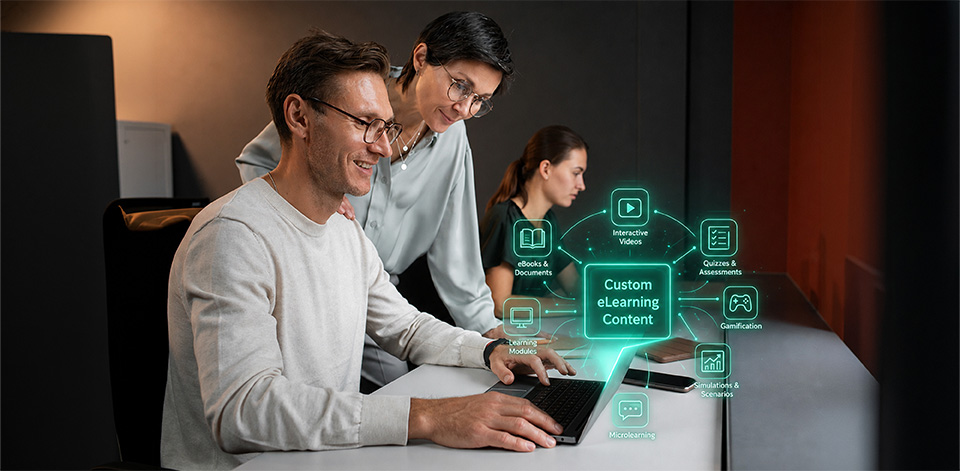
This kind of experience builds both awareness and judgment. And when this is delivered through custom eLearning solutions, aligned to your organization’s workflows and challenges, the impact becomes measurable.
Where Gamification Solutions Strengthen the Experience
Simulation alone builds realism. Gamification solutions add engagement and repetition.
By introducing elements like branching paths, time-bound decisions, scoring systems, and progression mechanics, learners stay involved longer and are more likely to revisit scenarios. This matters because capability improves with repeated exposure, not one-time completion.
For instance, a sales simulation with multiple negotiation paths encourages learners to try different approaches, understand trade-offs, and refine their strategy over time. That’s how learning moves from theory to habit.
Benefits of Simulation-Based Learning for Organizational Training
When implemented correctly, simulation-based learning delivers outcomes that traditional training struggles to achieve:
- Faster Time to Competency
Employees get exposure to real-world situations early, reducing the time it takes to perform effectively on the job.
- Consistent Training Across Locations
Every learner experiences the same scenarios, ensuring alignment across distributed teams.
- Reduced Risk in High-Stakes Roles
Employees can practice critical decisions without real-world consequences, which is essential in compliance-heavy or customer-facing roles.
- Measurable Performance Insights
Simulations generate data on decision patterns, enabling L&D teams to identify skill gaps and improve training continuously.
Challenges Organizations Face with Simulation (And How to Solve Them)
Simulation is powerful but scaling it across an organization comes with challenges.
Challenge 1: Development Complexity
Creating realistic simulations requires deep domain understanding and strong instructional design.
How to solve it:
Partner with experienced eLearning development companies like Ozemio that specialize in building scalable, high-impact simulations.
Challenge 2: Lack of Business Relevance
Generic scenarios fail because they don’t reflect actual job realities.
How to solve it:
Invest in custom eLearning that mirrors your organization’s decision-making environments, workflows, and challenges.
Challenge 3: Difficulty Scaling Across Roles
Different roles require different levels of complexity and context.
How to solve it:
Design modular, role-based simulations within a broader bespoke eLearning framework.
Strategies to Scale Simulation-Based Learning Across the Organization
Scaling simulation isn’t about producing more content. It’s about building a system that grows with your organization.
- Prioritize High-Impact Use Cases
Start with areas where performance gaps directly affect business outcomes:
- Sales effectiveness
- Leadership transitions
- Compliance and risk management
This ensures visible ROI early.
- Build Role-Specific Learning Journeys
Avoid generic training. Map simulations to roles and responsibilities.
A frontline employee should experience operational challenges, while a senior leader navigates strategic decisions.
- Integrate with Existing Systems
Simulation should connect with your LMS and performance tools so learning data feeds into broader talent strategies.
- Use Data to Continuously Improve
Track how learners make decisions, where they struggle, and how they improve.
This allows L&D teams to refine content based on actual performance, not assumptions.
- Create Reusable Frameworks
Instead of building from scratch every time, develop simulation templates that can be adapted across teams and functions.
This is what makes scaling sustainable.
How Ozemio Helps Organizations Scale Training Effectively
Ozemio works with the leading organizations to solve a very specific challenge: how to scale training without compromising on real-world readiness.
We combine:
- Custom eLearning designed around your business context
- Advanced simulation-based learning that builds decision-making capability
- Scalable bespoke eLearning frameworks for organization-wide deployment
- Engaging game eLearning elements that drive retention and repeat practice
Our approach is grounded in how work actually happens inside organizations. We offer custom content development that reflects real decisions, real risks, and real outcomes.
This ensures training translates into capability building and performance.
If training doesn’t prepare employees to handle real situations, it doesn’t scale, no matter how widely it is deployed. Simulation based learning changes that by turning training into practice and practice into capability. Build enterprise-ready, simulation-driven custom eLearning with Ozemio.
Ready to Transform Your Workforce Performance?
The gap between knowing and doing is where your organization’s potential lives.