
The Learning Curve Is Broken. Here’s What Comes Next
June 23, 2026
Simulation-Based Learning: The New Gold Standard in Healthcare Workforce Development
May 28, 2026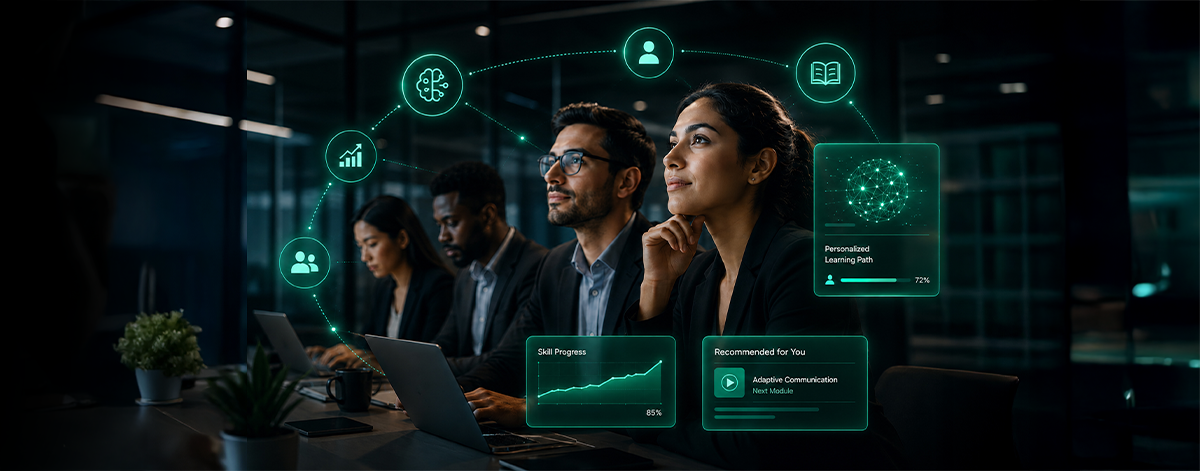
AI microlearning is the new leadership test today. How to build skills fast enough for a changing workforce? Yet, many organizations are still treating AI as a chatbot experiment.
By 2026, more than 75% of enterprises are expected to adopt AI-augmented development tools, according to a Gartner forecast cited by Forbes and USA Today.
That shift matters because the half-life of skills keeps shrinking, and employees need support in the flow of work, not only in formal classes.
Bloomberg projects the AI in education and training market could reach $20 billion by 2026.
Most of the conversation about generative AI in L&D over the last two years has centered on ChatGPT. But generic chatbots are just the first, most basic iteration of this technology.
The shift that will actually redefine corporate learning is AI microlearning.
What AI Microlearning Looks Like in Practice?
Traditional learning often starts with content, then hopes behavior changes later. That model struggles when teams are busy, distributed, and expected to learn while delivering work.
AI microlearning solutions reverses that pattern. It matches learning to role, skill level, prior performance, and moment of need, then adjusts the next step based on what the learner does.
Where Traditional Learning Falls Short?
A long course can build awareness, but awareness alone rarely changes performance. Employees forget details, managers lose visibility, and the business sees completion numbers without meaningful capability growth.
|
Traditional Approach |
AI Microlearning Approach |
Typical Business Result |
|
One-size-fits-all course catalog |
Role-based learning paths |
Faster time to competence |
|
Annual refresher sessions |
Timed prompts and practice |
Better recall and application |
|
Long learning modules |
Short learning moments |
Higher completion and less friction |
|
Completion-focused reporting |
Skill and behavior data |
Clearer corporate training ROI |
In practice, this means a new hire does not need to sit through every module in the same order. A sales rep might get a two-minute product recap before a client call, while a manager receives a coaching prompt after a difficult conversation.
How AI Microlearning Supports Business Outcomes?
The strongest case for AI microlearning is not convenience. It is performance.
Onboarding That Reduces Time to Productivity
In onboarding, AI can identify what a new hire already knows and remove repetition. That shortens ramp time and gives managers earlier proof that the employee can contribute.
This becomes especially important in fast-growing organizations, where every week of delayed productivity has a cost. Personalized pathways help new hires focus on the tasks, policies, and decisions that matter most in their role.
Compliance Training
Compliance training often fails when it is treated as an annual event instead of a daily behavior issue. AI microlearning can surface the right rule at the right moment, which makes the learning more practical and easier to remember.
For example, a field employee can receive a short reminder before a regulated task, instead of trying to recall a policy from a quarterly module. That kind of reinforcement supports risk reduction without adding heavy training time.
Leadership Development That Fits the Real Job
Leadership growth is often slowed by generic programs that ignore the manager’s current challenges. AI microlearning can recommend coaching prompts, scenario practice, and peer learning based on what a leader is dealing with now.
That is where generative AI in L&D becomes useful. The goal is to help each manager take the next best step with more precision.
What to Measure?
|
Learning Use Case |
What to Measure |
What Improves |
|
Onboarding |
Time to productivity, manager confidence |
Faster ramp and earlier contribution |
|
Compliance |
Completion, decision accuracy, repeat errors |
Lower risk and better consistency |
|
Upskilling |
Skill progression, internal mobility |
Stronger workforce capability |
|
Leadership development |
Behavior change, engagement, retention |
Better management quality |
A useful rule is simple: if the learning does not change a decision, behavior, or result, it is not enough on its own.
Common Mistakes That Limit Results
Many teams treat AI microlearning like a content problem. That creates activity without clearer performance or business results. The real issue is missing links between learning and work.
Watch for these mistakes before scaling AI microlearning programs:
- Designing for completion only: Link each learning moment to a real work task
- Leaving managers out: Involve managers in reinforcement and coaching
- Skipping governance: Review data for accuracy, fairness, and usefulness
- Measuring the wrong outcomes: Track behavior change, not only completion rates
Recommendations for Learning Leaders
A practical starting point is one business problem, one learner group, and one measurable outcome. For example, improve new manager readiness, reduce safety errors, or shorten sales onboarding.
A Simple Starting Plan
- Define the performance gap and the metric behind it.
- Map the work moments where learning should appear.
- Build short content around tasks, decisions, and common errors.
- Use an adaptive learning solutions with clear rules.
- Give managers simple prompts for reinforcement.
- Track recall, behavior change, and business impact.
This is where adaptive learning solutions matter most. They help organizations move from broad content delivery to personalized support that adapts as people learn.
The goal is not to replace formal learning. It is to make learning more useful between classes, meetings, and customer interactions.
Conclusion
AI microlearning is about delivering the right support at the right time, so learning turns into stronger performance and better business results.
For L&D leaders, the opportunity is clear: start with business need, design for the flow of work, and measure what changes. That is how AI-driven professional growth becomes part of organizational effectiveness, not just a new learning trend.