Skills-Based Learning in Manufacturing – A Practical Guide for L&D Teams
May 26, 2026
How Manufacturers Are Using Immersive Learning to Upskill Faster
May 6, 2026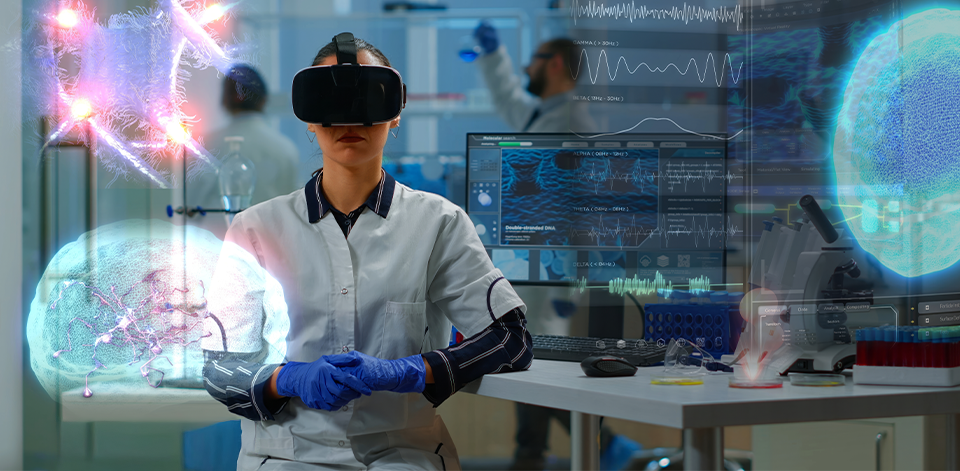
Table of contents
- What Is Immersive Learning in Healthcare?
- Immersive learning in clinical settings includes:
- Types of Clinical Teams That Benefit Most From Immersive Learning
- How to Implement Immersive Learning in a Healthcare Organization
- The Implementation Challenge Most Organizations Underestimate
- How Ozemio Designs Immersive Learning That Transforms Clinical Teams
- The Future of Clinical Training Is Already Here
- Other Articles
Clinical training has always carried life-or-death stakes. It's time the methods reflected that.
Every year, healthcare organizations pour billions into staff training orientation programs, compliance modules, classroom instruction, and on-the-job shadowing. Yet a gap persists between what clinical teams learn in training and what they can confidently execute at the point of care.
The reason is not a lack of effort. It is a mismatch between method and need.
Healthcare is a high-stakes, high-pressure, deeply human profession. It demands rapid clinical decision-making, crisis communication, procedural precision under stress, and cross-functional team coordination.
These skills cannot be built through passive learning alone. Watching a slide deck about sepsis management does not prepare a nurse for the moment a patient decompensates at 2 a.m. This is why immersive learning is rapidly becoming the gold standard for training clinical teams.
What Is Immersive Learning in Healthcare?
Immersive learning in healthcare is a training approach that places learners inside realistic, high-fidelity scenarios where they must actively think, decide, and act.
Immersive learning engages multiple cognitive and emotional systems simultaneously. It replicates the conditions of real clinical environments, such as time pressure, ambiguity, and interpersonal complexity, in a space where mistakes carry learning value rather than patient risk.
Immersive learning in clinical settings includes:
- High-fidelity clinical simulation — Using mannequins, standardized patients, or hybrid models to replicate patient encounters, emergencies, and procedures
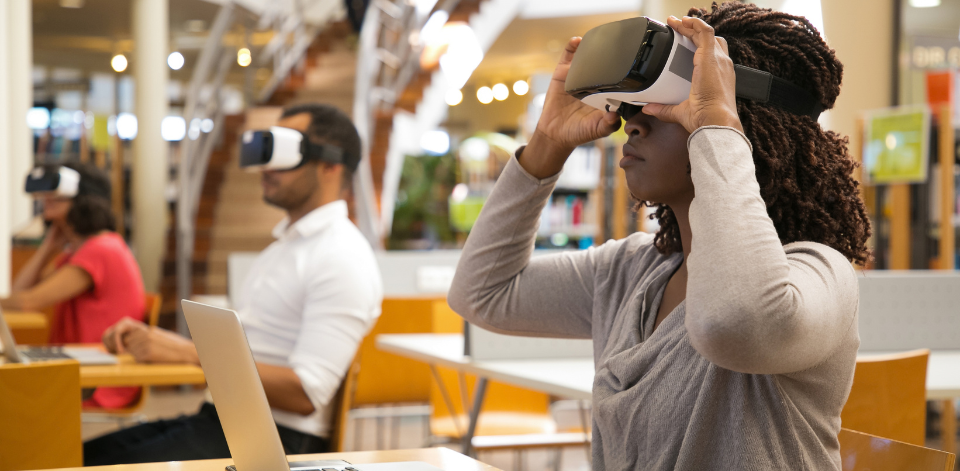
- Virtual Reality (VR) training — Placing learners inside fully rendered 3D clinical environments using headsets, allowing for repeated, scalable practice of skills like surgical procedures, airway management, and trauma response
- Augmented Reality (AR) — Overlaying digital information onto real-world clinical environments to guide procedural training or anatomy education in context
- Scenario-based and case-based learning — Branching narrative simulations where learners navigate complex clinical decisions with real consequences built in
- Gamification and serious games — Game mechanics applied to clinical training, including scoring, challenge progression, and team-based missions that build both skill and motivation
- Standardized patient programs — Trained actors portraying patients in scripted scenarios to develop communication, empathy, and behavioral skills that simulations alone cannot replicate
Each modality serves different learning objectives. The most effective immersive learning programs blend several of these into a cohesive, role-specific curriculum.
Types of Clinical Teams That Benefit Most From Immersive Learning
While immersive learning has value across the entire healthcare organization, the impact is most pronounced for:
- Emergency and critical care teams — Where decision speed and team synchronization under pressure are non-negotiable
- Surgical and procedural teams — Where technical precision, muscle memory, and spatial awareness are safety-critical
- Nursing staff — Particularly around medication administration, deteriorating patient recognition, and complex wound care
- New graduate and early-career clinicians — Who need accelerated competency development within compressed supervision windows
- Leadership and charge nurses — Building conflict resolution, ethical decision-making, and staff management under operational stress
- Interdisciplinary care teams — Developing shared mental models and communication norms across role boundaries
How to Implement Immersive Learning in a Healthcare Organization
Implementing immersive learning effectively requires more than purchasing a VR headset or booking a simulation lab.
Step 1 — Conduct a Training Needs Analysis
Identify the specific skill gaps, performance failures, and patient safety priorities driving the need for improved training. Data from incident reports, quality metrics, and competency assessments should inform this.
Step 2 — Define Learning Objectives by Role
Immersive learning works best when it is highly specific. Generic training produces generic results. Map objectives to observable, measurable behaviors for each clinical role group.
Step 3 — Select the Right Modalities
Match the immersive format to the objective. Procedural skills → simulation or VR. Team communication → interdisciplinary scenario simulation. Empathic communication → standardized patient programs. Cognitive decision-making → case-based digital simulation.
Step 4 — Design for Deliberate Practice
Build in repetition, escalating challenge, immediate feedback, and structured debriefing. The debrief, where learners reflect on what happened and why, is often where the deepest learning occurs.
Step 5 — Integrate with Broader Learning Pathways
Immersive experiences are most effective as part of a blended curriculum, not as isolated events. Connect simulation sessions to prerequisite knowledge modules, follow-up clinical assignments, and ongoing performance support.
Step 6 — Measure and Iterate
Define success metrics before deployment: clinical competency scores, incident rates, time-to-competency, and learner satisfaction. Use this data to refine and improve programs continuously.
The Implementation Challenge Most Organizations Underestimate
Many organizations invest in impressive simulation infrastructure or VR platforms and then populate them with learning experiences that are no more engaging or effective than the slide decks they replaced.
Building high-impact immersive learning programs requires deep expertise in instructional design, clinical knowledge, adult learning science, and measurement strategy. This is a multidisciplinary capability that few internal L&D teams have fully in-house.
This is where a specialized learning partner makes the decisive difference.
How Ozemio Designs Immersive Learning That Transforms Clinical Teams
Ozemio works with healthcare organizations to design, develop, and deploy immersive learning solutions that are purpose-built for clinical environments and grounded in evidence-based learning science.
We begin with the performance outcomes your organization needs, such as reduced adverse events, faster onboarding, stronger team communication, and higher competency scores, and design backwards from there. Every immersive experience we create is role-specific, rigorously designed, and built to be measurable.
Our healthcare learning capabilities include:
- Clinical simulation scenario design: Scripted, debriefing-ready scenarios for high-stakes team training
- Scenario-based digital learning: Branching, decision-driven learning experiences that build clinical judgment
- VR and AR learning integration: Partnering with leading platforms to create context-specific immersive modules
- Blended learning program architecture: Building immersive experiences into cohesive role-based learning journeys
- Impact measurement frameworks: Connecting training outcomes to patient safety, staff retention, and operational performance metrics
We have helped clinical teams at hospitals, health systems, and specialty care organizations build the capabilities they need to deliver exceptional care, even as the demands on their workforce continue to grow.
The Future of Clinical Training Is Already Here
Immersive learning is not an emerging trend to monitor. It is a proven, accessible, scalable approach that is already transforming clinical team performance at healthcare organizations around the world.
The teams delivering the safest, highest-quality care tomorrow will be the ones trained in environments that reflect the full complexity of clinical reality today.
Your workforce development strategy determines your patient outcomes. Make it count.